Did you ever watch someone and think: that does not fit the situation?
A manager who snaps at a small mistake. A colleague who laughs at a serious moment. Someone who goes quiet when you ask a simple question, or who hears a friendly remark as an attack.
Maybe you judged it. Maybe you just didn’t understand it. But most likely there was no plan behind it. The person did not sit down and decide to react like that. It just happened. That is automatic behaviour.
And here is the uncomfortable part: you do it too. We all do. Smell pipe tobacco and for a second you are back with your grandfather. You didn’t decide that. Your mind did it for you. And it does the same thing at work.
I know this from myself. When people don’t do what they promised, or when something gets in the way of my planning, my first thoughts are not friendly. Idiots. Losers. I don’t say it, but you can see that I am not happy.
Recently the bank made a mistake. My card was blocked and my automatic payments did not go through. They had to order a new card, which would take less than two weeks. Fine. Just before the two weeks were over, I passed by to check. The card was not there yet, but the friendly lady checked and said it was in process and would arrive soon. Fine. After two weeks I went to pick it up. You can already guess: no card.
I felt something starting inside me, but I stayed calm and asked her to check the timeline. She made a phone call, in Setswana. I don’t speak it well, but I could hear that something was not OK. She finished the call and said that something had gone wrong with the order, so they had to do it again. As if nothing had happened.
I stood up and walked away. Not a word. It was better for her and for me. What was different this time? Not that I wasn’t angry. I was. But I knew exactly what was going on inside me, and I chose what to do with it.
What people see
Your team can’t see your intentions. They can’t see your good plans or your knowledge. They see what you do and how you do it: your tone of voice when something goes wrong, whether you keep your promises, how you walk in on a Monday morning, how you react when someone disagrees with you.
That is your behaviour. And behind it is your attitude: how you stand towards people and situations. Management is not about your title. It is about behaviour and attitude. That is what people follow, or avoid.
You may act differently at work and at home, and that is normal. But the core of who you are travels with you, so your attitude and behaviour show up everywhere.
Where does your behaviour come from?
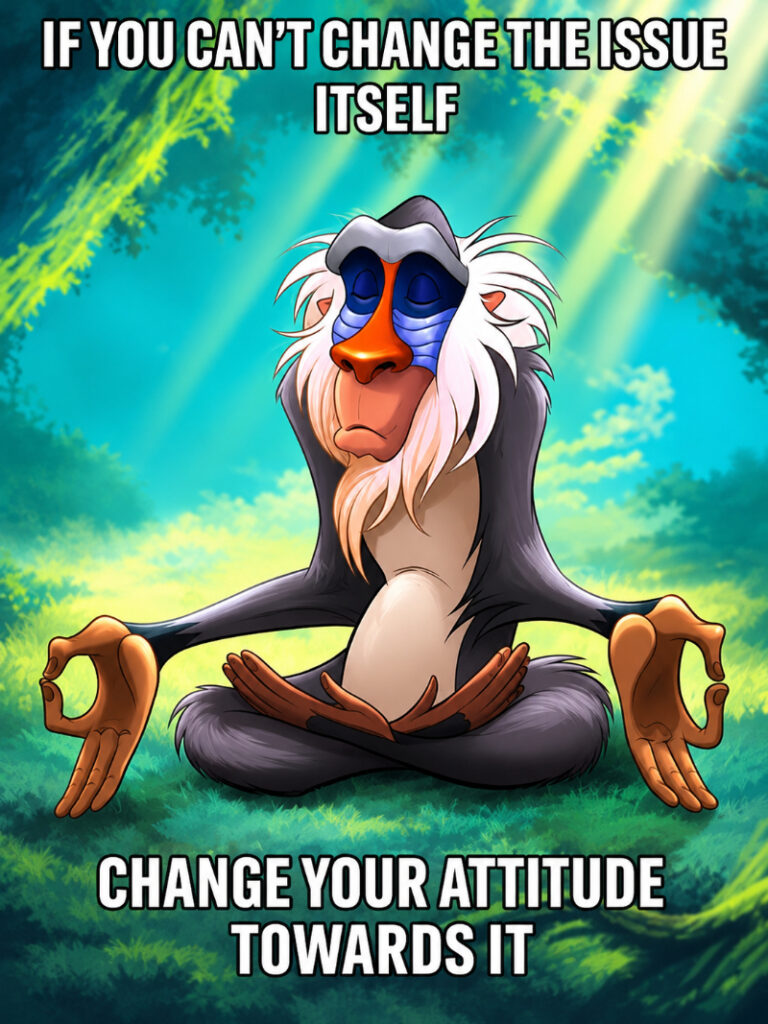
From the choices you make. Every reaction is a choice: to stay calm or to snap, to listen or to interrupt, to ask or to assume.
But here is the surprise. Most of these choices are not made consciously. Your mind stores everything you have lived through: how you grew up, school, religion, culture, good and bad experiences. You don’t remember most of it. But it is all used, every day. And your automatic mind is much faster than your thinking mind. It reacts first. The thinking mind often arrives later and explains why you did it. Psychologist Daniel Kahneman describes this as a fast, automatic way of thinking and a slow, careful way. The fast way runs most of our day.
You may think you decide consciously. Sorry, mostly you don’t. Much more is decided in the background than we think.
That is why, in the same situation, you often show the same behaviour again and again, even when it doesn’t help you. You see something or hear something, and you react. Autopilot.
Your automatic mind is also your friend
Don’t get me wrong: the automatic mind is not the enemy.
- It saves energy. You don’t have to think about how to drive a car or how to greet a guest.
- It is fast. Under pressure you act before you have time to think.
- It holds your experience. A “gut feeling” is often years of experience speaking.
But it uses the past to react to the present. If today looks like something from your past, it reacts the same way, even when this time it is different. So the goal is not to get rid of your autopilot. The goal is to know when to trust it, and when to stop and think.
Ask yourself
- Why do I want to be a manager?
- What drives me?
- What kind of manager/leader do I want to be?
- What do my people see when they look at my behaviour?
Try this week: catch the moment
- Think of a situation that happens often: someone did not do what was promised, or did not keep an agreement. The report is not ready. The delivery did not arrive. “I will do it tomorrow” turns into next week. The next time it happens, stop for three slow breaths before you react.
- Ask yourself two questions: What do I feel in my body right now? What story am I telling myself about this person?
- Then decide how you want to respond, as the manager you want to be.
In the evening, take two minutes and write down one moment: what happened, what was my first reaction, and what did my team see? After a week you will see a pattern. Some you will like. Some you won’t. That is exactly why it works.
Start with yourself
Planning, delegating, giving feedback: these are tools. But tools are used by a person, and that person shows behaviour and attitude all day long. If you don’t know how you lead yourself, even the best tools will be used on autopilot.
That is why we at Okavango Leadership Academy promote starting all management programs with the Self Leadership training. First the person, then the skills.
So, what is your team seeing today: you, or your autopilot?
Peter Henssen
