
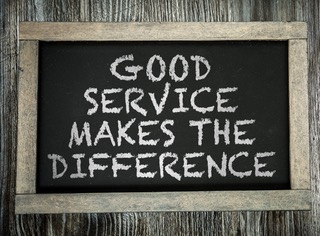
What do you remember when you go to a restaurant, buy new clothes, bring your car to the mechanic, or stay at a lodge? There may be several things, but in most cases, you remember the service, especially when it was bad, or exceptional. The same is true in reverse. Your customers, your clients, your guests, they remember you by the service you gave them, not just the product you sold them.
I have come to believe the exact same thing is true inside a team. Your employees remember you the same way a guest remembers a lodge: not primarily for the strategy, the targets, or the title on your door, but for how it felt to work with you. Service isn’t just something you deliver to the person paying the bill. It’s something you deliver to the people who work for you, every day, whether you think of it that way or not.
Understanding what people actually need
Good service starts with understanding what your client expects and, where you can, doing a little more than that. It’s what turns a first-time customer into a returning one.
I live somewhere without phone reception, so I depend entirely on internet. When it goes down, I expect my supplier to understand the urgency and act on it and not tell me they will come out in three days, or that they don’t have transport available.
That same expectation exists inside a team, and most managers miss it. When someone on your team hits a blocker, “Iwill get to it next week” lands exactly like the internet company’s three-day promise. It tells them their problem isn’t your priority. Understanding what’s actually urgent for the people who depend on you, and acting on it, isn’t a customer-service skill. It’s a management skill.
Doing it right the first time
Good service also means doing things right the first time, so you are not going back and forth fixing what should have been right from the start. Every round trip costs you time, energy, and money and your profit quietly vanishes.
The same principle applies to how you manage. Give unclear instructions, skip the training, or delegate a task without checking someone actually understands it, and you will be redoing the work yourself later or watching your team redo it. That “fixing it twice” cost isn’t just time. It chips away at your team’s confidence and your own credibility as much as a botched repair job chips away at a mechanic’s.
When good service becomes too much
The hospitality industry generally understands this well…arguably, sometimes too well. You can take service so far that you create expectations you can’t consistently meet.
I see this in management too, usually as over-promising or over-involvement. A manager who says yes to every request, hovers over every task to make sure it’s “done right,” or promises turnaround times they can’t sustain is doing the management equivalent of over-servicing a guest. It feels generous in the moment. Over time, it sets an expectation you can’t keep, and the eventual letdown costs more trust than a more honest boundary would have.
What I have learned living in Botswana
After a few years living here, I have unfortunately experienced a fair amount of bad service and most of it comes down to correcting something that should have been done right the first time. There are a few recurring reasons for that: unskilled employees, rushing to get paid quickly, and businesses becoming victims of their own success.
I have watched this pattern repeat itself: someone starts out doing genuinely great work. Word spreads. They get more work than they can realistically handle, and can’t find – or train – people they trust to do the job the way they would do it themselves. Quality slips, not because they stopped caring, but because they never built the capacity to sustain what made them good in the first place.
That is, almost word for word, the story of a manager promoted because they were an excellent individual contributor. They were great at the job. Nobody taught them how to lead people at the job, and nobody helped them build a team they could actually trust to carry the standard once it wasn’t just them doing the work anymore. The skill gap isn’t a character flaw, it’s an unaddressed training gap, exactly like the unskilled employee behind the counter.
And this is where the hardest lesson applies to both worlds equally: saying no is part of giving great service. A business that keeps taking on more than it can deliver ends up delivering worse for everyone. A manager who keeps taking on more than their team can absorb…more projects, more direct reports, more “yes”.., ends up managing worse for everyone. Protecting your capacity to actually do the job well is not a failure of ambition. It’s a condition of good service.
Service is key in every profession
Whatever industry you are in, whatever role you hold, service sits at the core of every lasting relationship; with your team, your clients, your customers. It isn’t a department. It isn’t a job title. It’s a mindset that shapes how people experience working with you, and if you are a manager how your team experiences working for you.
Service builds trust and loyalty
Think about the last time you kept using a supplier, a shop, or a service provider not because they were the cheapest, but because of how they made you feel: heard, valued, taken care of. That’s the essence of service.
The same mechanism drives whether your best people stay or leave. Good employees rarely quit over pay alone, they leave managers who didn’t make them feel heard, valued, or taken care of. When you consistently show up for the people who depend on you, whether they are your team or your clients, you build the foundation for trust. And trust is what turns a one-time transaction, or a first job, into a lasting relationship.
It’s not about getting it right the first time, it’s about what you do when you don’t
Here’s the part most people overlook: perfection isn’t what builds loyalty. Recovery does.
No supplier gets it right every time. No manager does either. Mistakes happen; a missed deadline, a miscommunication, a decision that didn’t land the way you meant it to. What actually determines how someone values you isn’t whether the mistake happened. It’s how you respond to it.
Do you own it? Do you fix it quickly, without excuses? Do you make the person feel like their concern genuinely matters to you…whether that person is a client with a broken product or a team member with a legitimate grievance?
That moment – the second chance – is often where trust is built more strongly than if nothing had gone wrong at all. People remember how you made things right far more than they remember the mistake itself. As a manager, admitting you got it wrong and fixing it in front of your team is one of the most underused trust-building tools available to you.
Service is attitude and behaviour, not a policy
You can’t fake service with a script or a policy document. It shows up in attitude and behaviour, in the tone of an email, the willingness to listen, the effort to actually understand what the other person needs.
This is true whether you are:
- A manager creating the conditions for your team to succeed,
- A supplier delivering a product,
- Or a service provider handling a client’s concern.
The common denominator is the same: service is a choice you make in how you show up, every single time not a policy you follow when it’s convenient. No handbook, HR policy, or performance framework will build trust for you. Only your actual behaviour will.
The takeaway
Service isn’t a department, a job description, or a one-time gesture. It’s a mindset, one that shows up in small moments of attitude and behaviour, and especially in how you handle it when things don’t go as planned.
And if you manage people, that mindset doesn’t stop at your customers. Your team is also being served – or not – by you, every day. Get that right, and you don’t just deliver a product or a service. You build trust. And trust is what brings people back, whether they are your customers, or your best people deciding to stay.
